Greene County Arkansas
Paragould, AR
Centennial Edition Section 1
=============================================================================================================
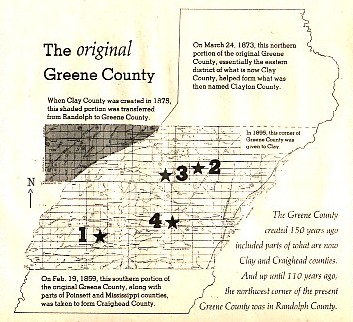
County Seats of Greene County 1833 ~ 1983
| 1. Ben Crowley's home 1833~1835 The Arkansas Territorial Assembly, in the act creating and naming Greene County, designated Benjamin Crowley's house as the temporary county seat until other accommodations could be made. The first court is said to have convened under the shade of twin oaks, near a spring on the Crowley grounds. When Crowley's Ridge State Park was built, the tree was marked with a tablet by the National Park Service. The Crowley home is thought to have occupied a site near the present swimming lake. 2. Paris 1835~1840 In about 1835, a group of county commissioners, assigned the task of locating a permanent conty seat, "selected a vacant hewed log house about 18 feet square in an obscure village called Paris, about five miles northest of the present town of Gainesville," Vivian Hansbrough wrote in her History of Greene County. The county then included the eastern half of Clay County and part of northern Craighead County, making Paris more certrally located then than it would be today. According to Hansbrough and other sources, Paris never contained more than a couple of stores and a few homes, no traces of which remain. 3. Gainesville 1840~1884 According to the Goodspeed history, after pressure for relocation of the courthouse, the site now known as Gainesville "gained" the honor and a name in 1840. (Other sources cite 1848, but that may be an early typographical error perpetuated in later references since the same sources note that Gainesville had a log courthouse in 1846. At least six Gainesville buildings, three of which were destroyed by suspicious fires, were used at various times by the county. A log courthouse -- along with a log jail -- was erected soon after the town gained the county seat. It was replaced by a three-story frame building, 30 feet square, housing the county offices, courtroom and a Masonic meeting hall. This building was burned in 1874 along with a portion of the county records. |
A storeroom rented for temporary use was burned later the
same year, destroying the rest of the county records. Another storeroom was burned in
1876, destroying the few county records that had accumulated since the 1874 fires. All three fires were believed to have been set by arsonists, presumably persons under criminal indictment, intent on destroying implicating court records. Existing court records start with cases which had to be dropped because the official documents had been destroyed. Sheriff F.S. Wright was shot and killed reportedly as a result of the 1874 fires but his assailant was never prosecuted. Reportedly, two persons were arrested for arson but escaped from jail and were never apprehended. After the 1876 fire, the county rented a room above James R. and Richard Jackson's store and appointed a building commissioner to oversee construction of a temporary courthouse. The last Gainesville courthouse, a one-story frame building, was used until the county seat was moved to Paragould in 1884. "Old Court Square" was sold in 1888 for $132. 4. Paragould 1884 ~ Present Paragould has had only three courthouse buildings and the first two were intended to be temporary. When the records arrived from Gainesville, they were stored at County Clerk R.H. Gardner's residence (or the Ben Wood home, depending on the source) on Main Street until a temporary courthouse was located in a long box building on the north half of the lot later occupied by First Methodist Church at the northeast corner of Main and Third streets --- "between the present locations of the Cities Service Station and the Masonic Hall," according to Hansbrough's 1946 book. This frame building was used as a temporary courthouse while preparations were underway for construction of the county's first brick courthouse. That building, completed in 1888, still stands although it has endured a number of changes including the addition of a coat of stucco and a vault annex in 1918, removal of its gracious clocktower in 1967, construction of two wooden "doghouses" and various changes such as the digging of an underground bomb shelter and relocation of the main stairway in 1979. |
Transcribed by: PR Massey