

Jim Crow Car
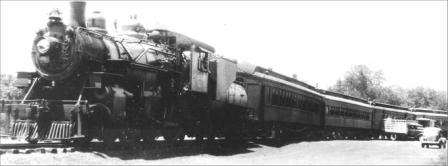
- E.G. Baker photograph/James R. Fair collection/Boone County Heritage Museum
By Jim Wakefield
In a ritual once performed thousands of times daily all across the United States, this photo shows a stake truck backed up to the side door of the Railway Post Office section of Missouri & Arkansas Railway Baggage-Mail No. 55 for the exchange of outgoing for incoming mail with the Railway Mail Service clerks on the RPO. Beyond it appears to be a Railway Express Agency truck, positioned next to the baggage section for similar exchange of express shipments. M&A Combine No. 57 brings up the rear of the train. Both cars originally were mail-passenger combines with 30-foot RPO apartments and seating for 36 passengers in the coach section. Number 55 was converted to baggage-mail in 1931. Number 57 apparently was converted to a “Jim Crow” car for standby service between Kensett and Helena, backing up Brill Motor No. 605, which entered service on or about August 2, 1937.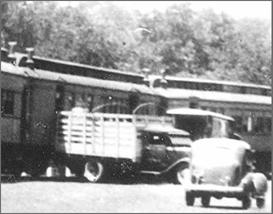 The fourth passenger window (from the car center) appears to be painted white, which was a common practice for toilet windows. Physical examination
of Number 57 suggests that a partition was installed to separate “white” and “colored” passengers as required by segregation laws of the time.
Scars on the wall, ceiling and floor suggest a toilet was added at that fourth window. After such changes, the car would have had a capacity
of about “20W 14C.” The car’s RPO fixtures also may have been removed since the Helena-Kensett RPO was discontinued on or about July 19,
1937, and the only mail carried south of Kensett thereafter was “closed pouch,” which was allotted space in the baggage section. The clerestory of
No. 57 originally had nine windows on each side in the RPO section and 10 on each side in the passenger section. All those in the RPO section
appear to have remained in place through the end of service, but seven of those on each side of the passenger section were removed and the openings
boarded up, leaving only the first, fifth and ninth windows to provide extra light and ventilation. The boarded-up windows can be seen in this
photograph. Number 57 was retired in 1945. Probably between then and 1949, its car body was sold and set on the ground at Searcy very near
the former M&NA main line to be used as a residence. On June 14, 2007, it was moved to Bald Knob by the White County Historical Society for
preservation and restoration as part of a new rail equipment exhibit. It is the last known surviving M&NA passenger car.
The fourth passenger window (from the car center) appears to be painted white, which was a common practice for toilet windows. Physical examination
of Number 57 suggests that a partition was installed to separate “white” and “colored” passengers as required by segregation laws of the time.
Scars on the wall, ceiling and floor suggest a toilet was added at that fourth window. After such changes, the car would have had a capacity
of about “20W 14C.” The car’s RPO fixtures also may have been removed since the Helena-Kensett RPO was discontinued on or about July 19,
1937, and the only mail carried south of Kensett thereafter was “closed pouch,” which was allotted space in the baggage section. The clerestory of
No. 57 originally had nine windows on each side in the RPO section and 10 on each side in the passenger section. All those in the RPO section
appear to have remained in place through the end of service, but seven of those on each side of the passenger section were removed and the openings
boarded up, leaving only the first, fifth and ninth windows to provide extra light and ventilation. The boarded-up windows can be seen in this
photograph. Number 57 was retired in 1945. Probably between then and 1949, its car body was sold and set on the ground at Searcy very near
the former M&NA main line to be used as a residence. On June 14, 2007, it was moved to Bald Knob by the White County Historical Society for
preservation and restoration as part of a new rail equipment exhibit. It is the last known surviving M&NA passenger car.
For additional information and a slide show on the railcar restoration project, go to www.whitecounty.us
vvv